

Introduction
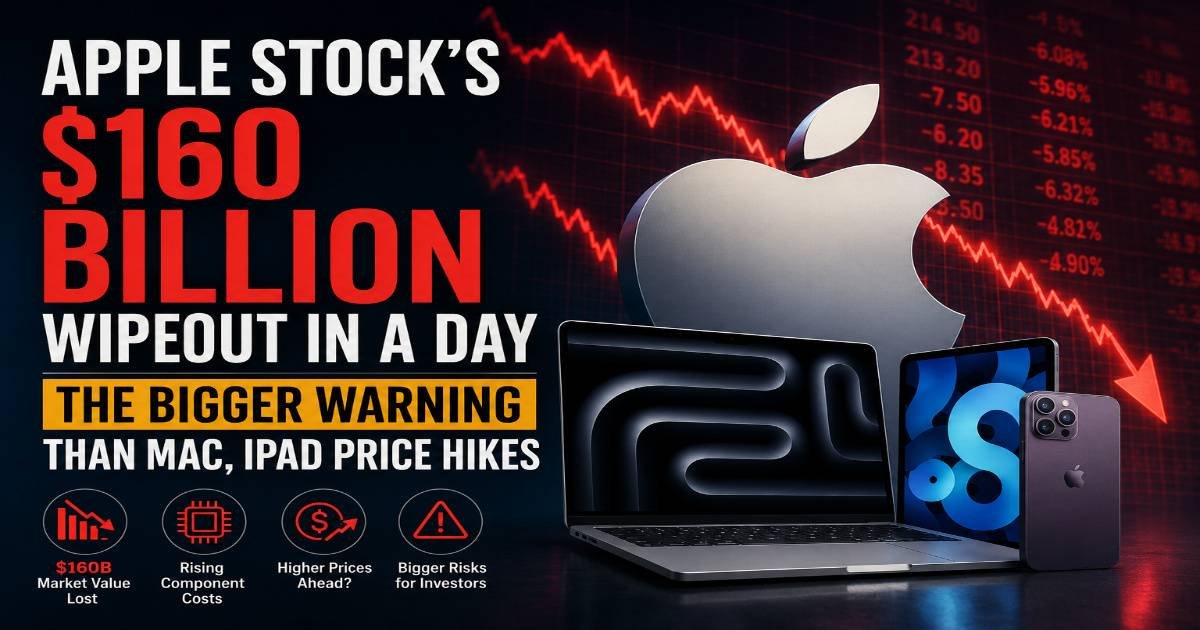
Apple Stock’s $160 Billion Wipeout has become one of the biggest financial stories of the week, wiping out nearly $160 billion in market value in a single trading session. While many headlines focused on higher prices for Macs and iPads, the sharp sell-off reflects much deeper concerns among investors.
The real issue isn’t just the latest round of hardware price hikes. Analysts believe the decline signals growing worries about rising memory costs, pressure on Apple’s profit margins, and the possibility that future iPhone models could also become more expensive. As artificial intelligence fuels unprecedented demand for advanced semiconductor components, Apple faces a new challenge: protecting its premium business model while keeping products attractive to consumers.
In this article, we’ll break down what caused Apple’s massive stock decline, why Wall Street reacted so strongly, and what it means for investors, Apple customers, and the broader technology sector.
What Triggered Apple’s $160 Billion Market Value Loss?
Apple’s shares fell more than 6% in a single day, wiping out approximately $160 billion in market capitalization. Although Apple remains one of the world’s most valuable companies, such a sharp decline immediately caught the attention of Wall Street.
The immediate catalyst was the company’s decision to raise prices on certain MacBook and iPad models after the cost of memory and storage components increased significantly. Memory manufacturers have been raising prices as demand for advanced chips has surged, particularly because of the rapid expansion of artificial intelligence infrastructure.
At first glance, the price increases appeared reasonable. Many businesses pass higher production costs on to customers, especially when inflation or supply shortages affect manufacturing expenses.
However, investors weren’t worried about the current price increases alone. They were looking ahead.
The market began asking a much bigger question:
If Apple is already raising prices on Macs and iPads because component costs are climbing, could the same thing eventually happen to the iPhone?
That question changed the conversation entirely.
Why Rising Memory Costs Matter More Than You Think
Most consumers rarely think about the memory chips inside their devices. Yet these components have become one of the most important cost drivers in modern electronics.
The explosive growth of artificial intelligence has dramatically increased demand for high-performance memory chips used in AI servers and data centers. Companies developing large AI models require enormous computing power, and that demand has pushed memory prices higher across the industry.
Apple purchases these components in massive quantities for Macs, iPads, iPhones, and other products. Even relatively small increases in chip prices can translate into billions of dollars in additional annual costs.
Apple now faces two difficult options:
- Absorb the higher costs and accept lower profit margins.
- Pass the additional costs on to customers through higher retail prices.
Neither choice is ideal.
Lower margins could disappoint investors, while higher prices could reduce consumer demand.
That balancing act explains why the market reacted so aggressively.
The Bigger Concern: Apple’s Pricing Power Is Being Tested
For years, Apple has enjoyed exceptional pricing power.
Customers have consistently been willing to pay premium prices because of the company’s reputation for quality, software integration, security, and ecosystem advantages.
But every company has its limits.
Consumers worldwide are still dealing with inflation, higher interest rates, and rising living costs. Many households have become more cautious about discretionary spending.
If Apple continues increasing prices across multiple product categories, some buyers may delay upgrades or keep their existing devices longer.
Even a modest slowdown in upgrade cycles could affect quarterly revenue, particularly because Apple’s installed base is already enormous.
This doesn’t mean customers will suddenly abandon Apple.
Instead, it suggests that maintaining growth may become more challenging if production costs continue rising faster than consumer spending.
Why Investors Reacted Before the Problem Became Real
One of the biggest misconceptions about the stock market is that prices only move after financial results change.
In reality, markets are forward-looking.
Investors constantly evaluate what earnings might look like six months, one year, or even several years into the future.
Apple’s price increases signaled that manufacturing costs are becoming more difficult to manage.
That immediately raised several important questions:
- Could future iPhones become significantly more expensive?
- Will Apple be forced to sacrifice profit margins?
- Could consumers delay upgrades because of higher prices?
- Will competitors benefit if Apple raises prices too aggressively?
None of these outcomes are guaranteed.
But financial markets often react to uncertainty before certainty arrives.
That explains why a single announcement contributed to such a dramatic decline in Apple’s market value.
Why the iPhone Matters More Than Macs and iPads
Although Macs and iPads remain important parts of Apple’s product lineup, the iPhone continues to be the company’s biggest revenue driver.
Every major decision surrounding iPhone pricing carries enormous financial implications.
If higher component costs eventually force Apple to raise iPhone prices, investors worry that demand could soften in key markets where smartphone replacement cycles have already slowed.
Emerging markets may be particularly sensitive to additional price increases.
At the same time, premium Android manufacturers continue improving their flagship devices, giving consumers more alternatives than ever before.
While Apple still benefits from remarkable brand loyalty, investors recognize that no company is completely immune to changing consumer behavior.
AI: Opportunity and Challenge at the Same Time
Ironically, artificial intelligence is both helping and hurting Apple.
On one hand, AI features are expected to drive the next generation of Apple products and services, potentially encouraging users to upgrade their devices.
On the other hand, the AI boom has increased global demand for advanced semiconductor components, making them more expensive for hardware manufacturers.
This creates an unusual situation where the very technology expected to fuel Apple’s future growth is also increasing the cost of building its products.
Managing this trade-off will be one of Apple’s biggest strategic challenges over the next several years.
What Long-Term Investors Should Watch
Short-term stock declines often generate dramatic headlines, but experienced investors typically focus on broader trends rather than single-day movements.
Over the coming quarters, several factors deserve close attention:
- Whether component costs stabilize or continue rising.
- Apple’s ability to protect profit margins.
- Consumer response to higher hardware prices.
- Demand for future iPhone models.
- Growth in Apple’s high-margin services business.
- Progress in integrating AI features into its ecosystem.
These indicators will provide a much clearer picture of whether this sell-off represents a temporary market reaction or the beginning of a longer-term shift in investor expectations.
Is This a Buying Opportunity or a Genuine Warning?
Whenever Apple experiences a sharp decline, investors inevitably ask the same question: Is this the perfect time to buy, or is the market signaling a deeper problem?
The answer isn’t as straightforward as it may seem.
Apple has built a reputation for recovering from periods of uncertainty. Over the past decade, the company has navigated trade wars, chip shortages, global inflation, and slowing smartphone demand while continuing to generate billions in profit. Its ecosystem, brand loyalty, and growing services business have repeatedly helped it bounce back from temporary setbacks.
However, the current situation is different in one important way.
This isn’t simply about weaker iPhone sales or a delayed product launch. Instead, investors are questioning whether Apple’s long-standing formula of premium pricing and industry-leading profit margins can continue in an environment where hardware costs are rising rapidly.
If memory prices remain elevated for an extended period, Apple may find it increasingly difficult to maintain the balance between profitability and affordability.
That doesn’t necessarily make Apple a poor investment.
It simply means investors should pay closer attention to cost trends than they have in previous years.
Apple’s Biggest Strength Still Remains Intact
Despite the dramatic market reaction, it’s important not to overlook Apple’s biggest competitive advantages.
The company still possesses one of the strongest ecosystems in the technology industry.
Millions of customers own multiple Apple products—from iPhones and MacBooks to Apple Watches, AirPods, and iPads. These devices work together seamlessly, making it less likely that users will switch to competing platforms.
Apple also continues expanding its Services business, which includes:
- Apple Music
- iCloud+
- Apple TV+
- Apple Arcade
- AppleCare
- App Store commissions
- Apple Pay
Unlike hardware, services generally produce much higher profit margins and recurring revenue.
This diversification provides Apple with an additional cushion if hardware margins face temporary pressure.
Why Wall Street Is Watching Gross Margins Closely
One of Apple’s most closely monitored financial metrics isn’t revenue—it’s gross margin.
Gross margin measures how much profit Apple keeps after accounting for production costs.
Historically, Apple has maintained industry-leading margins because of:
- Premium pricing
- Efficient supply chain management
- Massive purchasing power
- Strong brand value
If component costs continue climbing faster than Apple can increase prices, those margins could gradually shrink.
Even a small decline in gross margin can have a significant impact on earnings because Apple generates hundreds of billions of dollars in annual revenue.
That’s why analysts are focusing less on today’s MacBook prices and more on future earnings reports.
The AI Boom: Friend and Foe
Artificial intelligence has become one of the biggest themes in the technology sector.
Ironically, Apple finds itself benefiting from AI while also facing new challenges because of it.
The Opportunity
Apple is expected to integrate more AI-powered features into future versions of iOS, macOS, and its hardware lineup.
Smarter Siri capabilities, enhanced photo editing, real-time translation, productivity tools, and on-device AI processing could encourage users to upgrade their devices.
If Apple successfully delivers meaningful AI experiences, it could create an entirely new upgrade cycle.
The Challenge
The same AI boom has dramatically increased global demand for advanced memory chips and semiconductor components.
Large cloud providers, AI startups, and enterprise companies are purchasing enormous quantities of high-performance hardware.
This competition pushes manufacturing costs higher for everyone—including Apple.
In other words, AI is creating both new revenue opportunities and new cost pressures simultaneously.
What Could Happen Next?
Looking ahead, there are several possible scenarios.
Scenario 1: Memory Prices Stabilize
If chip prices begin falling over the next year, Apple could regain much of its pricing flexibility.
Higher production costs would become less of a concern, easing pressure on profit margins.
This would likely reassure investors.
Scenario 2: Apple Continues Raising Prices
If costs remain elevated, Apple may continue increasing prices across selected product categories.
While loyal customers may continue buying Apple products, prolonged price increases could eventually slow upgrade cycles.
Scenario 3: Apple Absorbs the Costs
Rather than passing every cost increase to consumers, Apple could choose to protect market share by accepting slightly lower margins.
Although this strategy may reduce short-term profitability, it could strengthen long-term customer loyalty.
Scenario 4: AI Drives a New Upgrade Cycle
If Apple’s upcoming AI features prove compelling enough, many customers may upgrade regardless of modest price increases.
In that case, stronger demand could offset higher production costs.
What Should Investors Watch Going Forward?
Instead of focusing on daily stock movements, investors should monitor the following indicators over the coming quarters.
| Metric | Why It Matters |
|---|---|
| Gross Margin | Shows whether Apple is successfully managing rising production costs. |
| iPhone Sales | Apple’s largest revenue source and a key indicator of consumer demand. |
| Services Revenue | Higher recurring revenue can offset hardware pressure. |
| AI Product Adoption | Strong AI features could drive new upgrade cycles. |
| Memory & Semiconductor Prices | Directly affect Apple’s manufacturing costs. |
| Consumer Spending | Higher inflation could reduce demand for premium devices. |
These indicators will provide a clearer picture of Apple’s long-term trajectory than any single trading day.
Lessons for Long-Term Investors
One of the biggest takeaways from this sell-off is that markets often react to expectations rather than current reality.
Apple remains financially strong.
It continues generating significant cash flow, investing heavily in research and development, and maintaining one of the most valuable brands in the world.
However, investors now recognize that even industry leaders face challenges from rising production costs and shifting market conditions.
Rather than viewing this event as a sign of permanent weakness, it may be more useful to see it as a reminder that no company is completely immune to macroeconomic pressures.
For long-term investors, patience and attention to fundamentals remain more important than reacting to a single day’s headlines.
Frequently Asked Questions (FAQs)
Why did Apple stock lose around $160 billion in one day?
The decline followed investor concerns about rising component costs, hardware price increases, and the potential impact these factors could have on Apple’s future profitability and product pricing.
Did Mac and iPad price hikes alone cause the sell-off?
No. While the price increases were an immediate trigger, investors were more concerned about rising manufacturing costs and what they could mean for Apple’s broader product lineup, especially the iPhone.
Could future iPhone prices increase?
It’s possible if production costs remain elevated. However, Apple has not confirmed that future iPhone models will see similar price increases.
Is Apple still a strong long-term company?
Apple continues to benefit from a powerful ecosystem, recurring services revenue, strong brand loyalty, and substantial financial resources. Long-term performance will depend on how effectively it manages costs while maintaining demand for its products.
Should investors panic after this decline?
Large-cap technology stocks can experience significant short-term volatility. Investors often focus on long-term business fundamentals rather than reacting to a single day’s market movement.
Final Thoughts
Apple’s roughly $160 billion one-day market value decline serves as a reminder that even the world’s most valuable companies are not immune to changing market dynamics.
While higher prices for Macs and iPads captured the headlines, the real issue extends much further. Investors are increasingly focused on whether rising component costs—driven in part by the global AI boom—will pressure Apple’s profit margins, influence future iPhone pricing, and reshape the company’s growth strategy.
At the same time, Apple enters this period from a position of considerable strength. Its loyal customer base, integrated ecosystem, expanding services business, and financial resources provide significant resilience against temporary headwinds.
The coming quarters will reveal whether this sell-off proves to be an overreaction or an early warning of longer-term challenges. For investors, the most important metrics to watch will be component costs, gross margins, iPhone demand, and Apple’s ability to turn AI innovation into meaningful growth.
As always, market headlines may drive short-term volatility—but long-term investment outcomes are ultimately determined by business fundamentals, execution, and the company’s ability to adapt to a changing technology landscape.