

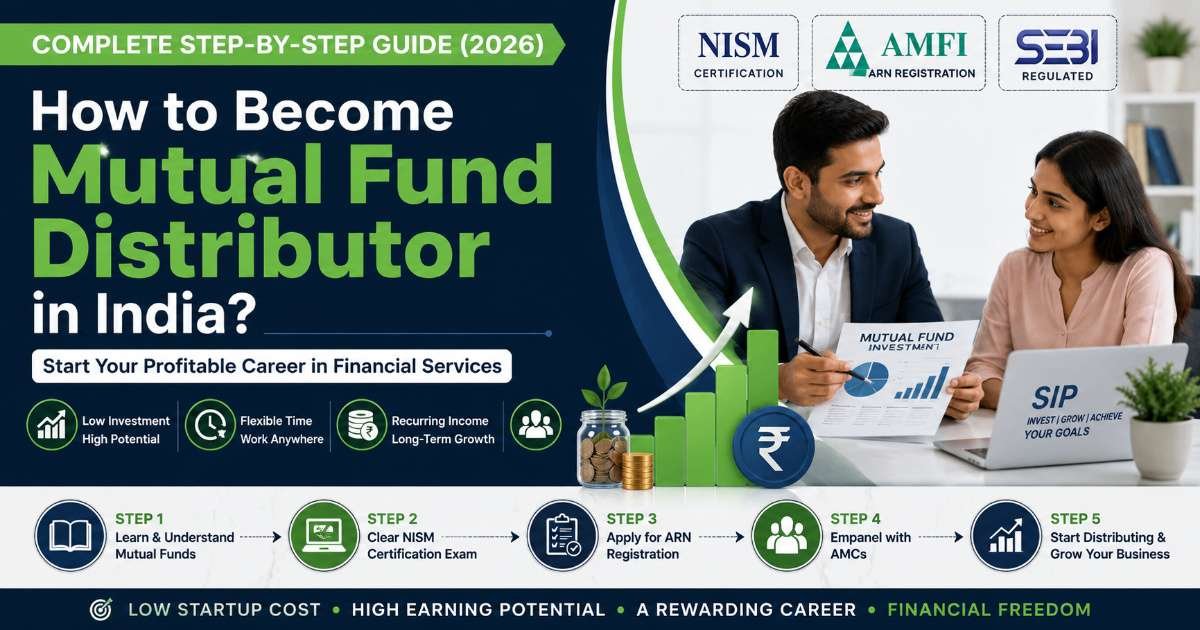
How to Become Mutual Fund Distributor in India
The Indian mutual fund industry is witnessing unprecedented growth. With millions of new investors entering the market every year through SIPs and digital investment platforms, the demand for qualified mutual fund distributors is also increasing rapidly. If you are looking for a career that offers recurring income, flexible working hours, and long-term wealth creation, becoming a mutual fund distributor can be an excellent opportunity.
Whether you’re a student, banker, insurance advisor, CA, financial planner, stock market enthusiast, or someone planning to start a financial services business, understanding How to Become Mutual Fund Distributor in India is the first step toward building a sustainable income source.
The best part is that you don’t need a massive investment to get started. With the right certification, registration, and client-focused approach, you can gradually build a large Assets Under Management (AUM) portfolio and earn recurring trail commissions for years.
What is a Mutual Fund Distributor?
A Mutual Fund Distributor (MFD) is an individual or organization authorized to recommend and distribute mutual fund schemes to investors. They help clients choose suitable mutual fund investments based on their financial goals while assisting with documentation, SIP registrations, portfolio reviews, and investment planning.
Distributors act as a bridge between investors and Asset Management Companies (AMCs). Instead of charging advisory fees in most cases, they primarily earn commissions from the AMCs based on the investments made through them.
Unlike stock trading, this business focuses on long-term relationships, making it possible to generate recurring income as client investments continue to grow.
Why Become a Mutual Fund Distributor?
India’s mutual fund penetration is still relatively low compared to many developed countries. As financial awareness increases, the industry offers significant opportunities for new distributors.
Some major advantages include:
- Low startup investment
- Flexible working hours
- Work from anywhere
- Recurring passive income
- No inventory required
- Growing investor base
- Unlimited earning potential
- Opportunity to build your own financial advisory business
A distributor who consistently acquires SIP clients can create a steady stream of monthly income that grows over time.
Growth of the Mutual Fund Industry in India
The Indian mutual fund industry has experienced remarkable expansion over the past decade. Factors contributing to this growth include:
- Increasing financial literacy
- Rising SIP investments
- Digital investment platforms
- Government initiatives promoting financial inclusion
- Higher disposable incomes
- Growing participation from young investors
As more people seek professional guidance for investing, mutual fund distributors are becoming increasingly important in helping investors make informed decisions.
Who Can Become a Mutual Fund Distributor?
One of the biggest advantages is that professionals from various backgrounds can enter this field.
You can become a distributor if you are:
- College graduate
- Working professional
- Banker
- Insurance advisor
- Chartered Accountant
- Tax consultant
- Financial planner
- Stock market enthusiast
- Retired professional
- Entrepreneur
- Business owner
No prior experience in mutual funds is mandatory, although financial knowledge certainly helps.
Eligibility Criteria
| Requirement | Details |
|---|---|
| Minimum Age | 18 Years |
| Education | Generally Class 12 Pass (or as permitted under applicable regulations) |
| PAN Card | Mandatory |
| Aadhaar | Required |
| Bank Account | Required |
| NISM Certification | Mandatory |
| ARN Registration | Mandatory |
Meeting these requirements is the first milestone in How to Become Mutual Fund Distributor in India.
Documents Required to Become a Mutual Fund Distributor
Before applying for your certification and registration, keep the following documents ready to avoid delays.
| Document | Purpose |
|---|---|
| PAN Card | Identity and tax compliance |
| Aadhaar Card | Identity verification |
| Passport-size Photographs | Registration process |
| Address Proof | KYC verification |
| Educational Qualification Certificate | Eligibility verification |
| Bank Account Details | Commission payouts |
| Cancelled Cheque | Bank verification |
| Email ID & Mobile Number | Official communication |
Having these documents prepared in advance can significantly speed up your registration process.
NISM Series V-A Certification Explained
The NISM Series V-A: Mutual Fund Distributors Certification Examination is the first mandatory step for anyone planning to distribute mutual funds in India.
The certification ensures that distributors understand:
- Mutual fund fundamentals
- Investment objectives
- Types of mutual fund schemes
- Risk management
- Asset allocation
- Taxation
- Regulations
- Investor protection
- Ethics and compliance
The exam is designed to ensure that investors receive advice from individuals with adequate knowledge of mutual fund products.
AMFI Registration Number (ARN) Explained
After successfully clearing the NISM certification, the next step is obtaining your AMFI Registration Number (ARN).
The ARN serves as your official identity as a registered mutual fund distributor. It enables you to distribute mutual fund schemes offered by different Asset Management Companies (AMCs).
Without an active ARN, you cannot legally distribute mutual funds or receive commissions from AMCs.
Employee Unique Identification Number (EUIN)
If you directly interact with investors and provide recommendations, you will generally require an Employee Unique Identification Number (EUIN).
The EUIN helps improve transparency by identifying the individual who advised the investor, strengthening accountability within the mutual fund distribution ecosystem.
Approximate Cost of Becoming a Mutual Fund Distributor
One of the biggest advantages of this profession is its low entry cost.
| Expense | Approximate Cost |
|---|---|
| NISM Examination Fee | ₹1,500–₹3,000 |
| ARN Registration & Related Charges | ₹3,000–₹4,000 |
| Miscellaneous Expenses | ₹500–₹1,500 |
| Estimated Initial Investment | ₹5,000–₹8,500 |
How Do Mutual Fund Distributors Earn Money?
This is one of the most common questions among aspiring distributors.
Mutual fund distributors generally earn through commissions paid by Asset Management Companies (AMCs). Investors do not directly pay these commissions.
The main income sources include:
1. Trail Commission
Trail commission is paid periodically as long as your clients continue investing and remain invested.
For example:
- A client starts a SIP of ₹10,000 per month.
- The investment grows over time.
- You continue earning trail commission based on the applicable commission structure.
As your Assets Under Management (AUM) increase, your recurring income can also grow.
2. Incentive Programs
Some AMCs may offer additional incentives based on factors such as:
- New SIP registrations
- Investor awareness campaigns
- Business milestones
- Promotional initiatives
These programs vary by AMC and may change over time.
How Much Can a Mutual Fund Distributor Earn?
There is no fixed salary. Your earnings depend on:
- Number of active clients
- Monthly SIP inflows
- Total Assets Under Management (AUM)
- Client retention
- Product mix
- Long-term business growth
Illustrative Income Potential
| AUM | Approximate Annual Income* |
|---|---|
| ₹50 Lakhs | ₹25,000–₹75,000 |
| ₹1 Crore | ₹50,000–₹1.5 Lakhs |
| ₹5 Crore | ₹2.5–₹7 Lakhs |
| ₹10 Crore | ₹5–₹15 Lakhs |
| ₹50 Crore+ | Significantly higher |
*Illustrative estimates only. Actual earnings vary based on commission structures, product mix, and regulatory norms.
Many experienced distributors manage portfolios worth several crores, creating a stable stream of recurring income.
How to Get Your First 100 Clients
Starting from zero can feel challenging, but a structured approach makes it achievable.
Start with Your Existing Network
Reach out to:
- Family
- Friends
- Colleagues
- Neighbours
- Local business owners
People who already know and trust you are often more willing to begin investing through your guidance.
Educate Before Selling
Instead of pushing products, explain concepts like:
- SIPs
- Power of compounding
- Goal-based investing
- Inflation
- Long-term wealth creation
Educational conversations build credibility and trust.
Build an Online Presence
Share valuable content consistently:
- SIP calculators
- Market updates
- Investment myths
- Personal finance tips
- Mutual fund education
Useful content helps attract potential clients organically.
Ask for Referrals
Satisfied clients can become your strongest source of new business. Encourage referrals after delivering a good experience.
Common Mistakes New Mutual Fund Distributors Make
Avoid these mistakes to build a sustainable business.
Selling Instead of Advising
Focus on understanding client needs rather than recommending products solely to increase business.
Ignoring Follow-Ups
Regular portfolio reviews and periodic communication help strengthen client relationships.
Lack of Continuous Learning
Mutual fund regulations, taxation, and investment products evolve. Stay updated through ongoing education.
Overpromising Returns
Never guarantee returns. Mutual funds are subject to market risks, and setting realistic expectations builds long-term trust.
Neglecting Digital Marketing
In today’s environment, a strong online presence can significantly improve client acquisition.
Compliance and Ethical Practices
The mutual fund industry is highly regulated, making ethics and compliance essential.
As a distributor, you should:
- Clearly explain investment risks.
- Recommend products based on the client’s financial goals and risk profile.
- Avoid making unrealistic return promises.
- Maintain proper documentation.
- Keep client information confidential.
- Stay updated with regulatory changes.
- Complete renewals and continuing education requirements on time.
Professional conduct builds trust and helps create a sustainable business.
Future Scope of Mutual Fund Distribution in India
India’s mutual fund industry continues to grow as more individuals adopt disciplined investing through SIPs and long-term financial planning.
Key growth drivers include:
- Rising financial awareness
- Increasing digital adoption
- Growing middle-class population
- Expansion into smaller cities and towns
- Higher participation from first-time investors
- Greater focus on retirement and goal-based investing
As the investor base expands, qualified mutual fund distributors are expected to play an increasingly important role in financial inclusion and wealth creation.
Frequently Asked Questions (FAQs)
Is the NISM certification mandatory?
Yes. The required NISM certification is an essential qualification before applying for registration as a mutual fund distributor.
Can students become mutual fund distributors?
Yes, provided they meet the applicable eligibility criteria, including the required educational qualification and certification.
How much investment is required to start?
The initial registration and certification expenses are generally modest, making this a relatively low-cost business to start.
Can I work part-time as a mutual fund distributor?
Yes. Many professionals, including insurance advisors, tax consultants, and salaried employees (subject to employer policies and regulatory requirements), begin this business on a part-time basis.
Is mutual fund distribution profitable?
It can be profitable if you consistently acquire clients, provide quality service, and build long-term Assets Under Management (AUM). Earnings typically grow with your client base and retained investments.
Final Thoughts
If you’re looking for a career that combines entrepreneurship, financial knowledge, and the opportunity to build recurring income, learning How to Become Mutual Fund Distributor in India is an excellent place to start.
The entry barriers are relatively low, but long-term success depends on your ability to educate investors, build trust, stay compliant, and provide consistent service.
Rather than focusing only on sales, aim to become a trusted financial partner for your clients. Over time, a well-served client base can grow through referrals and long-term investments, creating a sustainable and rewarding business.
Whether you’re starting as a side hustle or planning to build a full-time financial advisory practice, the journey begins with obtaining the required certification, completing your registration, and continuously improving your knowledge.