
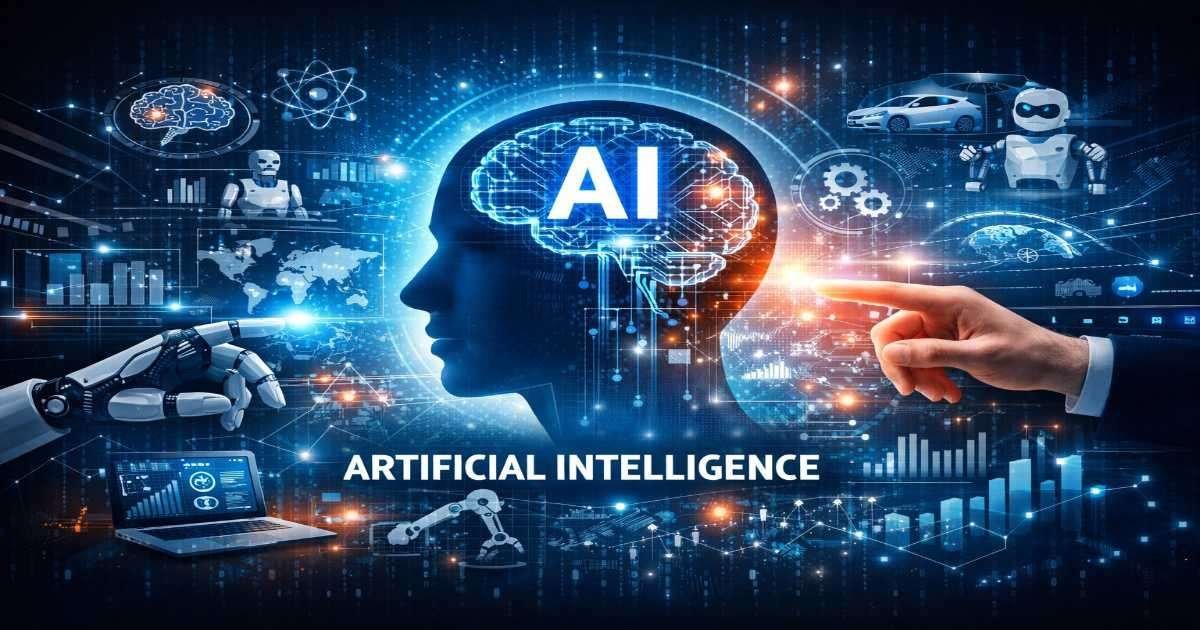
Artificial Intelligence (AI) is no longer just a concept from science-fiction movies. Today, AI is actively shaping the way we live, work, and communicate. From smartphones and social media to healthcare, finance, and education, AI has become a core part of modern technology. As businesses and individuals increasingly rely on smart systems, understanding AI has become more important than ever.
we will explain what Artificial Intelligence is, how it works, its types, real-life applications, advantages, disadvantages, and what the future of AI looks like—especially for students, professionals, and businesses.
What Is Artificial Intelligence (AI)?
Artificial Intelligence (AI) refers to the ability of machines or computer systems to perform tasks that normally require human intelligence. These tasks include learning from data, recognizing patterns, understanding language, making decisions, and solving problems.
In simple terms, AI allows machines to “think” and “act” intelligently. For example, AI-powered tools like ChatGPT can understand questions asked in natural language and respond in a human-like way. This is possible because AI systems are trained on large amounts of data and advanced algorithms.
How Does Artificial Intelligence Work?
Artificial Intelligence works by combining data, algorithms, and computing power. First, a large amount of data is collected from different sources such as text, images, videos, or numbers. This data is then processed using algorithms that help the machine identify patterns and relationships.
Most modern AI systems rely on Machine Learning (ML), where machines learn from past data and improve their performance over time without being explicitly programmed for every task. Advanced AI models also use Deep Learning, which is inspired by the human brain and uses neural networks to process complex information.
Types of Artificial Intelligence
Artificial Intelligence can be broadly divided into three main types.
The first type is Narrow AI (or Weak AI). This is the most common form of AI used today. Narrow AI is designed to perform a specific task, such as voice recognition, image classification, or recommendation systems. For example, search engines developed by Google use AI to deliver accurate and personalized search results.
The second type is General AI. This type of AI can understand, learn, and perform any intellectual task that a human can do. At present, General AI is still under research and development and does not fully exist in real-world applications.
The third type is Super AI. This is a theoretical concept where AI surpasses human intelligence in all aspects, including creativity, problem-solving, and decision-making. Super AI is considered the future stage of artificial intelligence.
Real-Life Applications of Artificial Intelligence
Artificial Intelligence is already being used in many industries and everyday activities. In education, AI helps create personalized learning experiences, online assessments, and smart tutoring systems. Students can learn at their own pace with AI-based platforms.
In healthcare, AI assists doctors in diagnosing diseases, analyzing medical images, and predicting patient outcomes. AI-powered systems can process medical data faster and more accurately than traditional methods.
In finance and stock markets, AI is used for fraud detection, algorithmic trading, risk analysis, and customer support. Many investors and institutions rely on AI tools to analyze large volumes of financial data.
In business and marketing, AI helps companies understand customer behavior, automate customer service through chatbots, and improve advertising strategies. Content creation, video editing, and image generation are also increasingly driven by AI.
Advantages of Artificial Intelligence
One of the biggest advantages of AI is efficiency. AI systems can work 24/7 without fatigue, completing tasks faster than humans. This improves productivity and reduces operational costs for businesses.
Another major benefit is accuracy. AI minimizes human error, especially in tasks that require data analysis, calculations, or pattern recognition. AI also helps in handling large volumes of data that humans cannot process easily.
AI improves decision-making by providing data-driven insights. It also enhances user experience through personalization, such as recommendations on shopping and streaming platforms.
Disadvantages and Risks of Artificial Intelligence
Despite its benefits, Artificial Intelligence also comes with challenges and risks. One major concern is job displacement. Automation powered by AI may replace certain repetitive or low-skill jobs, affecting employment.
Data privacy and security are also serious issues. AI systems require large amounts of data, which can be misused if not properly protected. Bias in AI algorithms is another concern, as biased data can lead to unfair or incorrect decisions.
There is also the risk of over-dependence on AI, where humans rely too much on machines and lose critical thinking skills. Therefore, ethical and responsible use of AI is essential.
The Future of Artificial Intelligence
The future of Artificial Intelligence looks extremely promising. AI is expected to play a key role in smart cities, autonomous vehicles, advanced healthcare, and scientific research. Countries around the world are investing heavily in AI development.
Many technology leaders believe AI will define the next phase of human progress. Organizations like OpenAI are working on advanced AI systems, while innovators such as Elon Musk frequently highlight both the potential and risks of AI.
For individuals, learning AI-related skills such as data analysis, machine learning, and prompt engineering can open new career opportunities.
Will AI Replace Humans?
A common question is whether AI will replace humans entirely. While AI may replace certain jobs, it will also create new roles that require creativity, strategy, and emotional intelligence. Humans and AI are more likely to work together rather than compete.
Those who adapt and learn to work with AI will have a strong advantage in the future job market.
Future of Artificial Intelligence
Artificial Intelligence (AI) is expected to play a transformative role in 2026 and beyond. Advanced AI systems developed by companies like OpenAI and Google are becoming smarter, faster, and more human-like in understanding language, images, and data. Experts believe AI will significantly impact healthcare, education, finance, and business automation. While concerns about job displacement and data privacy remain, many leaders—including Elon Musk—emphasize responsible and ethical AI development. Rather than replacing humans completely, AI is expected to enhance productivity and create new career opportunities. As governments work on AI regulations, the focus will shift toward safe innovation. The future of AI looks powerful, fast-growing, and deeply integrated into everyday life.
Conclusion
Artificial Intelligence is transforming the world at an unprecedented pace. It is not just a technological trend but a powerful tool that is reshaping industries, economies, and daily life. Understanding AI today is essential for staying relevant in the future.
Whether you are a student, professional, entrepreneur, or investor, learning about Artificial Intelligence can help you make better decisions and prepare for a technology-driven future.