

Introduction
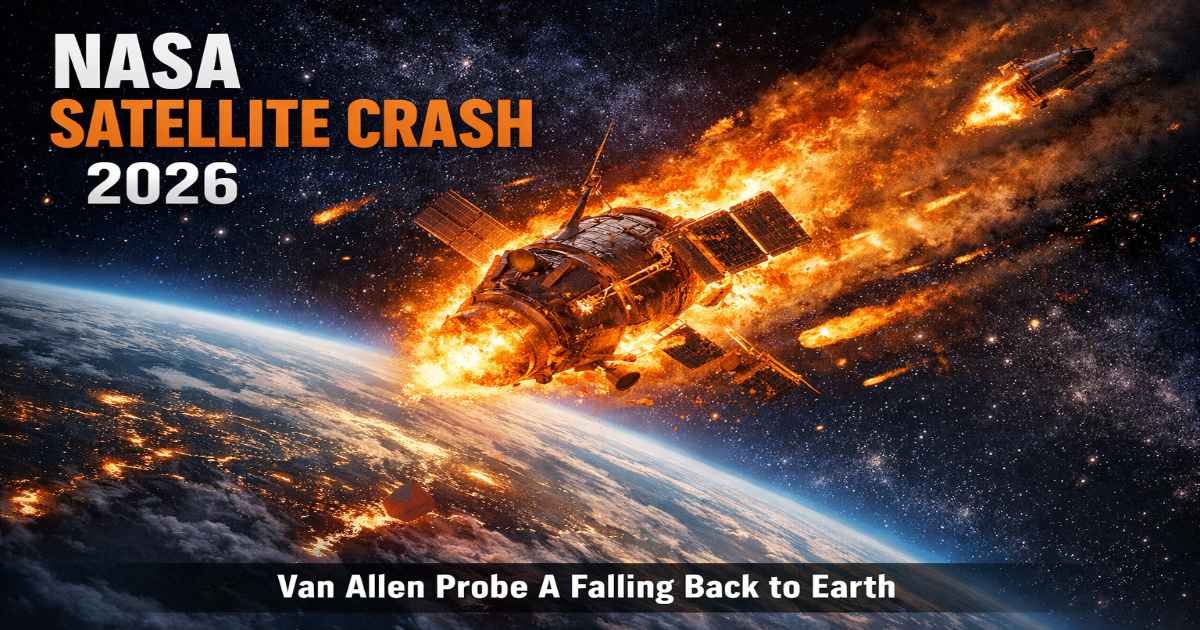
Recently, a major space news story has caught global attention — a satellite from NASA is expected to crash back to Earth after spending many years in orbit. The satellite, known as Van Allen Probe A, was launched in 2012 to study Earth’s radiation belts.
After completing its mission and remaining inactive for several years, the spacecraft is now re-entering Earth’s atmosphere.
Although the phrase “satellite crash” may sound alarming, scientists say the chances of harm are extremely low. Most parts of the spacecraft will burn up in the atmosphere before reaching the ground.
What is the NASA Satellite That Is Crashing?
The satellite involved in the news is Van Allen Probe A, a spacecraft launched by NASA in August 2012 along with its twin satellite Van Allen Probe B.
These satellites were designed to study the Van Allen radiation belts, which are regions of charged particles trapped by Earth’s magnetic field. These belts can affect satellites, astronauts, and even communication systems on Earth.
The mission was originally planned for only two years, but the satellites performed much longer and continued to provide valuable data until 2019. After its mission ended, Probe A slowly began losing altitude due to atmospheric drag.
Why Is the Satellite Falling Back to Earth?
Many people think satellites stay in space forever, but that is not true. Over time, several factors cause satellites to fall back toward Earth.
1. Atmospheric Drag
Even hundreds of kilometers above Earth, a very thin layer of atmosphere still exists. This creates resistance called atmospheric drag, which gradually slows down satellites.
2. Solar Activity
Solar storms and increased solar radiation can expand Earth’s upper atmosphere, increasing drag on satellites. This accelerates their descent toward Earth.
3. End of Mission
When satellites run out of fuel or complete their mission, they are no longer able to maintain their orbit. Eventually, gravity pulls them back.
When Will the NASA Satellite Crash?
According to predictions from space scientists, the satellite is expected to re-enter Earth’s atmosphere around March 2026, though the exact timing may vary.
During re-entry, the spacecraft will travel at extremely high speeds and heat up due to friction with the atmosphere.
As a result, most of the satellite will burn up and disintegrate before reaching the ground.
Is There Any Danger to People?
This is the question many people are asking.
Fortunately, experts say the risk is extremely small.
There are several reasons why the risk is low:
- 70% of Earth is covered by oceans
- Large parts of land are uninhabited
- Most of the spacecraft burns up during re-entry
Only a few small fragments might survive the fall.
What Happens When a Satellite Re-enters Earth?
When a satellite re-enters the atmosphere, several dramatic events occur.
Extreme Heat
As the spacecraft falls at speeds over 27,000 km per hour, friction with air creates intense heat.
Fireball Effect
The satellite may appear as a bright fireball streaking across the sky, similar to a meteor.
Breakup in the Atmosphere
Most parts of the spacecraft break apart and burn up long before reaching the ground.
Only strong materials such as titanium or steel components may survive.
The Mission and Achievements of Van Allen Probes
Despite its fiery end, the mission of Van Allen Probe A was considered highly successful.
Some key achievements include:
- Discovering a temporary third radiation belt around Earth
- Providing new insights into space weather
- Helping scientists understand how solar storms affect satellites
The data collected from the mission has helped improve satellite protection systems and space weather forecasting.
The Growing Problem of Space Debris
This satellite re-entry also highlights an important issue — space debris.
Today, thousands of satellites orbit Earth, including those from companies and space agencies worldwide. When old satellites stop working, they become space junk.
Space debris can create several problems:
- Collisions with active satellites
- Risks for astronauts
- Falling debris during re-entry
Scientists are now developing new technologies to safely remove old satellites from orbit.
Are Satellite Crashes Common?
Yes, satellite re-entries happen regularly.
Every year, many old satellites and rocket parts fall back into the atmosphere. Most of them burn up completely and go unnoticed.
Over the past decades, thousands of spacecraft have re-entered Earth’s atmosphere without causing major damage.
Conclusion
The news of a NASA satellite crash may sound frightening at first, but experts say there is very little reason to worry. The satellite Van Allen Probe A is simply completing its natural lifecycle after more than a decade in space.
Most of the spacecraft will burn up during re-entry, and any remaining fragments are highly likely to fall into the ocean or uninhabited areas.
Instead of being a disaster, this event is a reminder of how active human space exploration has become and how important it is to manage satellites responsibly.