
Introduction
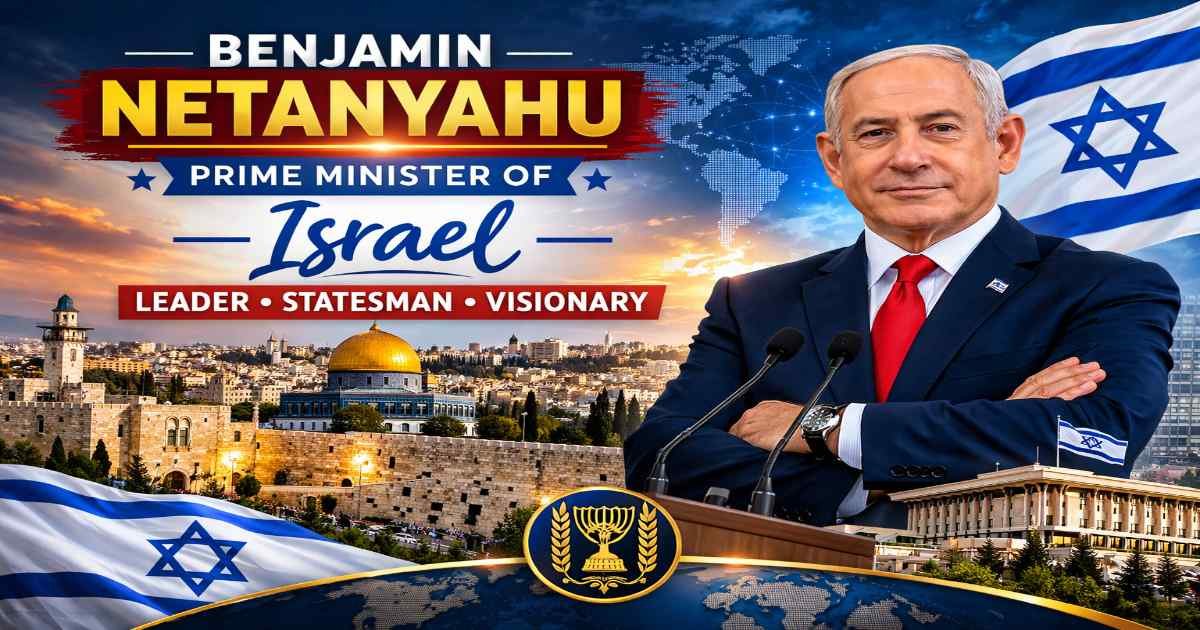
Benjamin Netanyahu is one of the most influential and controversial political leaders in modern Middle Eastern history. Serving multiple terms as the Prime Minister of Israel, Netanyahu has played a major role in shaping Israel’s domestic policies, international relations, and security strategies.
Known for his strong stance on national security, his complex relationship with global leaders, and his ability to remain politically relevant for decades, Netanyahu has become a central figure in Israeli politics. His leadership has seen economic growth, diplomatic breakthroughs, and also intense political debates and legal challenges.
Benjamin Netanyahu was born on October 21, 1949, in Tel Aviv. He grew up in a family deeply connected to Jewish history and Zionist ideology.
His father, Benzion Netanyahu, was a respected historian and scholar specializing in Jewish history. Because of his father’s academic career, Netanyahu spent part of his childhood in the United States, where he developed fluency in English and familiarity with Western culture.
Netanyahu attended Massachusetts Institute of Technology, where he studied architecture and management. He later completed additional studies at Harvard University, focusing on political science.
His time in the United States helped shape his global outlook and diplomatic skills, which later became an important asset in international politics.
Military Service
Before entering politics, Netanyahu served in the elite special forces unit of the Israel Defense Forces, known as Sayeret Matkal.
During his military service, he participated in several high-risk operations. One of the most notable missions associated with the unit was the Operation Entebbe, though his brother Yonatan Netanyahu was the commander who was killed during the mission and later became a national hero in Israel.
Netanyahu’s military background significantly shaped his views on security, counterterrorism, and defense policy.
Entry into Politics
Netanyahu’s political journey began in the 1980s when he worked as Israel’s ambassador to the United Nations from 1984 to 1988.
His strong communication skills and ability to defend Israel’s position on international platforms quickly gained global attention. After returning to Israel, he joined the Likud party, a right-wing political movement.
In 1993, Netanyahu became the leader of the Likud party and soon emerged as one of Israel’s most powerful political figures.
First Term as Prime Minister (1996–1999)
In 1996, Netanyahu made history by becoming the youngest Prime Minister of Israel at the age of 46.
During his first term, his government focused on:
- Strengthening national security
- Negotiating peace agreements with Palestinian leaders
- Expanding Israel’s economy and technology sector
His administration also implemented the Hebron Protocol, which involved redeploying Israeli forces from parts of the West Bank.
However, political disagreements and tensions eventually led to his defeat in the 1999 elections.
Return to Power (2009–2021)
After a decade in various political roles, Netanyahu returned to power in 2009, marking the beginning of one of the longest premierships in Israeli history.
During this period, Israel experienced:
- Strong economic growth
- Expansion of the high-tech sector
- Increased global diplomatic relations
One of the biggest diplomatic achievements came in 2020 with the signing of the Abraham Accords, which normalized relations between Israel and several Arab countries including the United Arab Emirates, Bahrain, Morocco, and Sudan.
These agreements were considered one of the most significant diplomatic breakthroughs in the Middle East in decades.
Relationship with Global Leaders
Throughout his career, Netanyahu built strong relationships with several world leaders.
One of his most notable alliances was with former Donald Trump, who supported several pro-Israel policies, including recognizing Jerusalem as Israel’s capital.
Netanyahu has also interacted with global leaders such as:
- Joe Biden
- Vladimir Putin
- Narendra Modi
These relationships helped strengthen Israel’s global diplomatic influence.
Legal Challenges and Controversies
Despite his political achievements, Netanyahu’s career has been surrounded by several controversies.
In recent years, he faced corruption allegations involving fraud, bribery, and breach of trust. These legal cases sparked massive political debates and protests within Israel.
Supporters argue that the charges are politically motivated, while critics believe they represent serious issues regarding political accountability.
The legal battles have become one of the defining aspects of Netanyahu’s recent political career.
Return as Prime Minister in 2022
In 2022, Netanyahu made a dramatic political comeback and once again became the Prime Minister of Israel after winning the national elections.
His return marked another historic moment, making him the longest-serving prime minister in Israel’s history.
His current government has focused on:
- Judicial reforms
- National security policies
- Managing regional tensions in the Middle East
However, these reforms have also triggered large public protests and debates about democracy and governance in Israel.
Netanyahu’s Political Legacy
Benjamin Netanyahu has left a deep and complex legacy in Israeli politics.
Supporters praise him for:
- Strengthening Israel’s global position
- Expanding diplomatic relations
- Maintaining strong national security policies
Critics argue that his leadership has increased political divisions within the country.
Regardless of opinions, Netanyahu remains one of the most significant political figures in Israel’s history.
Conclusion
The political journey of Benjamin Netanyahu reflects decades of leadership, resilience, and controversy. From his early days as a soldier and diplomat to becoming Israel’s longest-serving prime minister, Netanyahu has played a central role in shaping the nation’s modern identity.
As Israel continues to face regional challenges and internal debates, Netanyahu’s leadership and decisions will likely continue to influence the country’s future for years to come.