
Introduction
Skyscrapers have always been a symbol of human ambition, engineering excellence, and economic power. Over the last few decades, countries around the world—especially in Asia and the Middle East—have competed to build taller, smarter, and more sustainable buildings. These architectural giants are not just offices or residences; they represent technological advancement, tourism growth, and national pride.
As of 2026, the race for height is still dominated by Asia and the Middle East, with only a few entries from the Western world. In this article, we will explore the Top 10 Tallest Buildings in the World, including their height, location, purpose, and interesting facts that make them unique.
This list is based on architectural height, as recognized by international skyscraper standards.
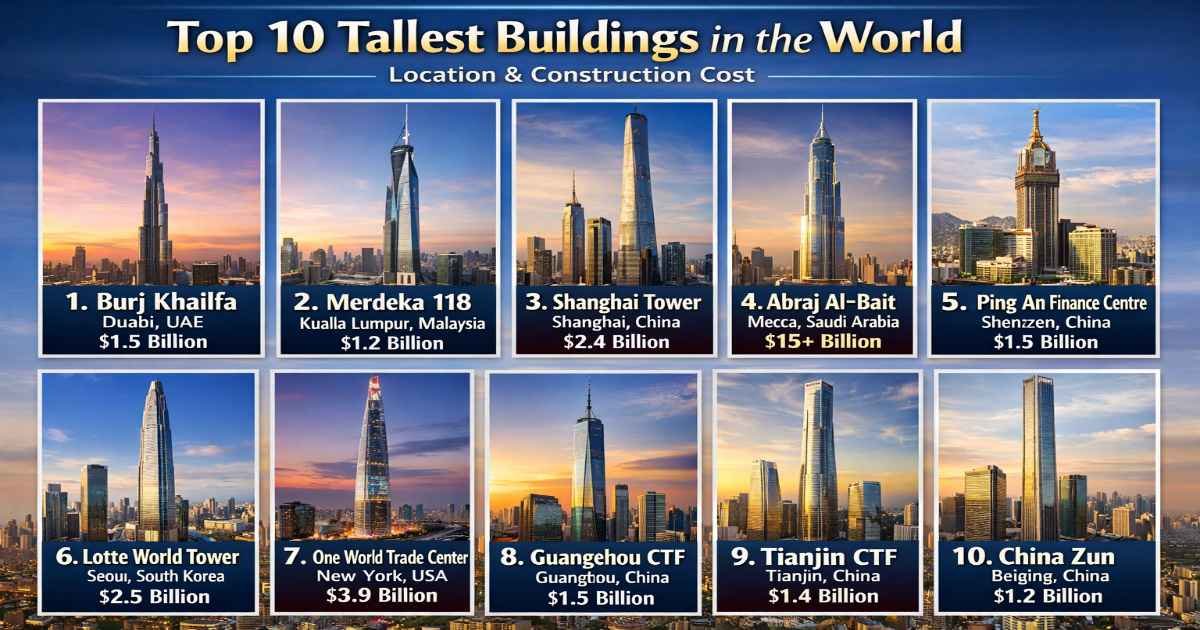
1. Burj Khalifa – The Tallest Building on Earth
- Location: Dubai, United Arab Emirates
- Height: 828 meters
- Completed: 2010
- Estimated Cost: $1.4–1.5 billion
- Approx Cost in INR: ₹12,000–13,000 crore
The Burj Khalifa remains unmatched as the tallest building in the world. Located in Dubai, this iconic skyscraper is a mixed-use structure featuring luxury apartments, corporate offices, the Armani Hotel, and observation decks.
The building was designed to withstand extreme desert heat and strong winds. Its Y-shaped design provides structural stability and allows more natural light. Burj Khalifa is also a major tourist attraction, welcoming millions of visitors every year.
Interesting fact: The observation deck on the 148th floor was once the highest in the world.
2. Merdeka 118 – Southeast Asia’s Tallest Tower
- Location: Kuala Lumpur, Malaysia
- Height: 678.9 meters
- Completed: 2023
- Estimated Cost: $1.2 billion
- Approx Cost in INR: ₹9,500–10,000 crore
Merdeka 118 is the second-tallest building in the world and the tallest in Southeast Asia. Its design is inspired by Malaysia’s independence heritage, reflecting national identity and modern architecture.
The tower includes offices, luxury hotels, observation decks, and retail spaces. It has also been praised for its sustainable building features and energy-efficient systems.
3. Shanghai Tower – China’s Tallest Building
- Location: Shanghai, China
- Height: 632 meters
- Completed: 2015
- Estimated Cost: $2.4 billion
- Approx Cost in INR: ₹18,000–19,000 crore
Shanghai Tower is known for its futuristic twisted design, which reduces wind load by nearly 24%. It houses offices, hotels, retail spaces, and cultural venues.
The building uses one of the fastest elevators in the world and focuses heavily on green technology, including rainwater harvesting and wind turbines.
4. Abraj Al-Bait Clock Tower – Home to the World’s Largest Clock
- Location: Mecca, Saudi Arabia
- Height: 601 meters
- Completed: 2012
- Estimated Cost: $15–16 billion
- Approx Cost in INR: ₹1.2 lakh crore
Located near the Grand Mosque in Mecca, the Abraj Al-Bait Clock Tower is primarily used to accommodate pilgrims. Its massive clock faces are visible from kilometers away.
This complex includes hotels, prayer halls, shopping malls, and Islamic museums, making it one of the most functional skyscraper developments in the world.
5. Ping An Finance Centre – Financial Powerhouse
- Location: Shenzhen, China
- Estimated Cost: $1.5 billion
- Approx Cost in INR: ₹11,000–12,000 crore
- Completed: 2017
- Height: 599 meters
Ping An Finance Centre serves as the headquarters of Ping An Insurance and houses offices, hotels, and retail areas. The tower reflects Shenzhen’s rise as a global financial and technology hub.
Its sleek, tapering form helps improve aerodynamic performance while maintaining a modern aesthetic.
6. Lotte World Tower – Korea’s Tallest Landmark
- Location: Seoul, South Korea
- Height: 555 meters
- Completed: 2016
- Estimated Cost: $2.5 billion
- Approx Cost in INR: ₹18,000–20,000 crore
Lotte World Tower is South Korea’s tallest building and a symbol of Seoul’s modernization. The building includes residences, offices, a luxury hotel, and one of the world’s highest observation decks.
Its design reflects traditional Korean ceramics blended with modern architecture.
7. One World Trade Center – America’s Tallest Building
- Location: New York City, United States
- Height: 541 meters
- Completed: 2014
- Estimated Cost: $3.8–3.9 billion
- Approx Cost in INR: ₹29,000–32,000 crore
Also known as the Freedom Tower, One World Trade Center stands as a symbol of resilience and renewal. It was built on the site of the former World Trade Center.
The height of 1,776 feet symbolizes the year of American independence. The building features advanced security systems and sustainable design elements.
8. Guangzhou CTF Finance Centre – Ultra-Fast Elevators
- Location: Guangzhou, China
- Height: 530 meters
- Completed: 2016
- Estimated Cost: $1.5 billion
- Approx Cost in INR: ₹11,000–12,000 crore
This mixed-use skyscraper includes offices, apartments, and a luxury hotel. It is known for having some of the fastest elevators in the world, reaching speeds of 20 meters per second.
9. Tianjin CTF Finance Centre – Elegant and Efficient
- Location: Tianjin, China
- Height: 530 meters
- Completed: 2019
- Estimated Cost: $1.3–1.6 billion
- Approx Cost in INR: ₹10,000–13,000 crore
Designed with a curved glass façade, this building minimizes wind resistance and improves energy efficiency. It serves commercial, residential, and hospitality purposes.
10. China Zun (CITIC Tower) – Inspired by Ancient China
- Location: Beijing, China
- Height: 528 meters
- Completed: 2018
- Estimated Cost: $1–1.5 billion
- Approx Cost in INR: ₹8,000–12,000 crore
China Zun gets its name from an ancient Chinese wine vessel. Its shape widens at the top and bottom, giving it both stability and cultural significance.
It is currently the tallest building in Beijing and a major commercial hub.
Inspired by an ancient Chinese wine vessel and the tallest building in Beijing.
Why Asia Dominates the Tallest Buildings List
Asia leads the skyscraper race due to rapid urbanization, economic growth, and population density. Countries like China, Malaysia, and South Korea invest heavily in infrastructure to attract global business and tourism.
In contrast, many Western countries prioritize zoning laws and historical preservation over extreme height.
Future of Skyscrapers
With advancements in engineering, future skyscrapers will focus more on sustainability, smart technology, and multi-use functionality rather than just height. Projects under planning stages may soon challenge current records.
Conclusion
The world’s tallest buildings are more than just concrete and steel structures. They are symbols of human innovation, cultural identity, and economic ambition. From the iconic Burj Khalifa to the culturally inspired China Zun, each skyscraper tells a unique story.
As technology evolves, the skyline of the future promises even more breathtaking architectural wonders.